How does peak shaving reduce your customers’ peak consumption?
A single quarter-hour in which several installations run at full power can weigh on your customers’ grid costs for months. Discover how peak shaving with a battery flattens those consumption peaks, and why smart control lets the battery generate returns on the energy market outside those peaks as well.

A single quarter-hour in which several installations run at full power simultaneously can saddle a business with extra grid costs for months. Peak shaving allows businesses to limit those consumption peaks. But why should a battery only absorb peaks when it can also generate returns on the energy market?
Why are there more consumption peaks?
Businesses are electrifying at full speed. Electric vehicles, heat pumps and other energy-intensive applications are increasingly replacing fossil-fuel alternatives. But when several installations draw electricity at the same time, high power peaks occur. And those peaks weigh on the energy bill.
Since the capacity tariff was introduced in Flanders in 2023, what counts is not only how much electricity a business consumes, but also how much power it draws from the grid at the same time.
For businesses connected to the low-voltage grid, the power drawn is recorded every quarter-hour. The highest quarter-hour power determines the monthly peak. The average of the monthly peaks over the past twelve months forms the basis for the capacity tariff.
For larger businesses with a medium- or high-voltage cabin, the access capacity also comes into play: the power a business sets as its maximum grid offtake. Exceeding it risks additional grid costs that continue to weigh on the following months as well.
The result? A single short consumption peak can have a financial impact that lasts far longer than that one quarter-hour.
Want to learn more about the principles of the capacity tariff? Be sure to read the information from the Flemish Utility Regulator (in Dutch).
Want to learn more about access capacity and how to set it correctly for your business? Be sure to read this blog post (in Dutch).
How does peak shaving with a battery work?
Peak shaving literally means “shaving off” consumption peaks. As soon as electricity consumption threatens to exceed a preset limit, a battery steps in. It temporarily supplies the additional power, so the business needs to draw less electricity from the grid.
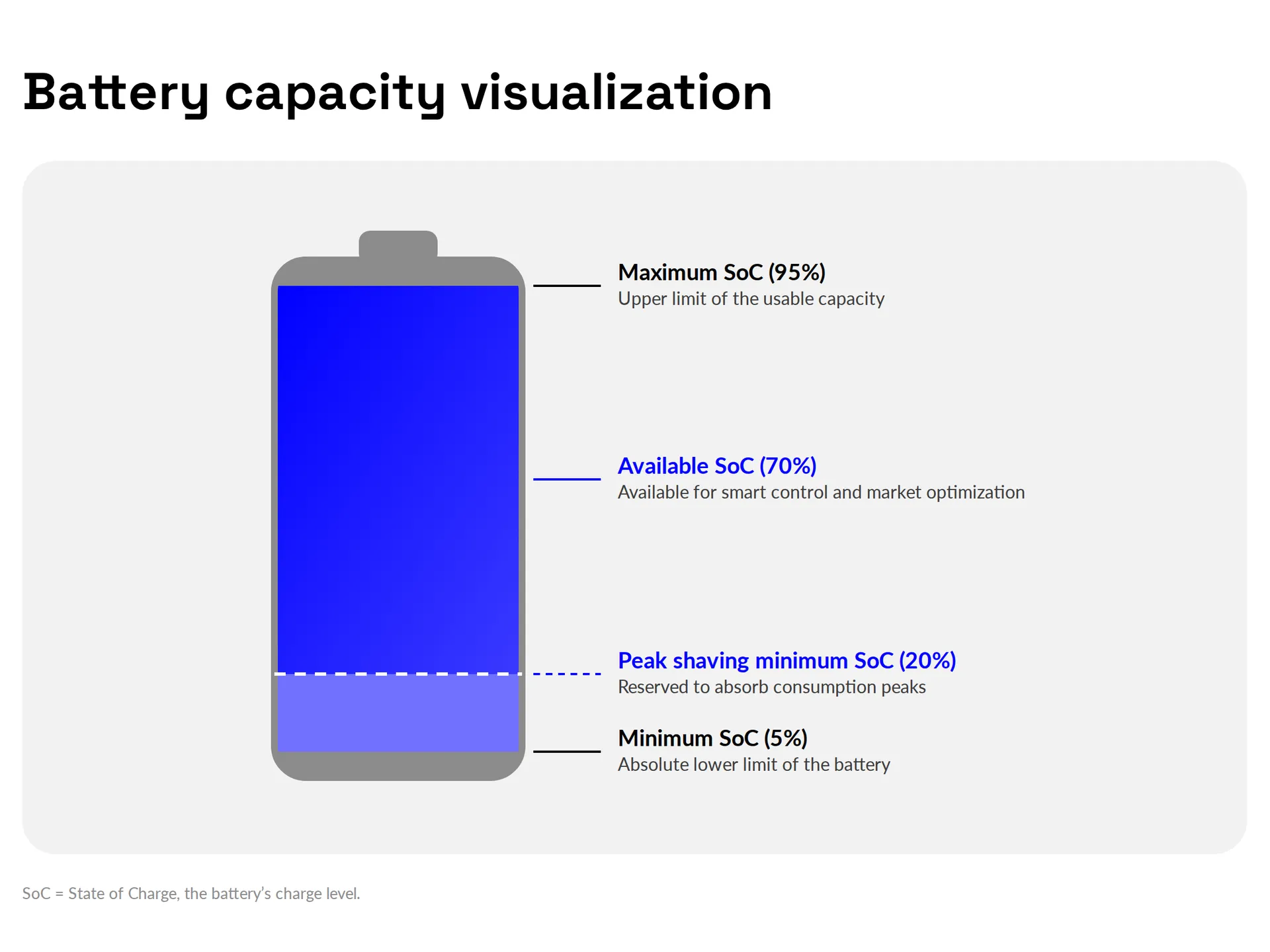
Stelmo offers peak shaving as an integrated feature of its smart battery control. The control signal continuously monitors grid offtake and automatically dispatches the battery when a peak is imminent. As soon as consumption drops again, the battery can be recharged. This keeps grid offtake under control, without the business having to interrupt its operations.
To intervene at the right moment, the control system reserves part of the battery capacity for peak shaving. How large that buffer needs to be depends on the site’s consumption profile.
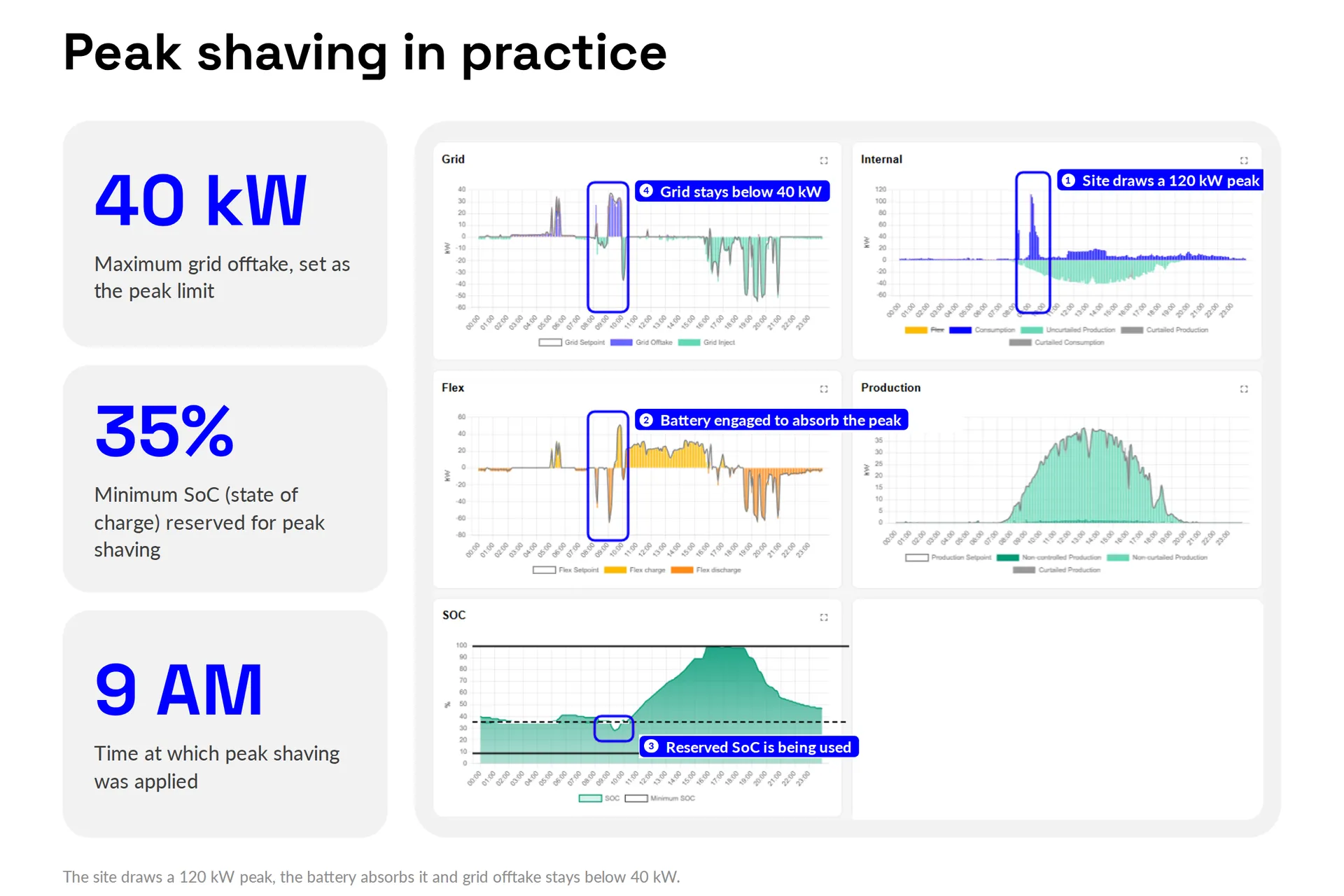
Peak shaving in practice: from 120 kW to less than 40 kW of grid offtake
At a business site with solar panels and a battery, the maximum grid offtake was set at 40 kW. To absorb unexpected peaks, the battery kept a minimum State of Charge (SoC) of 35% in reserve.
Around 9 a.m., power demand on the site rose to approximately 120 kW. The battery automatically stepped in and supplied additional power, keeping grid offtake below 40 kW.
After the peak, the battery was recharged. Later in the day, the solar panels charged the battery fully. Surplus solar energy was injected into the grid whenever the selling price worked in the customer’s favor.
The site was able to continue its operations as usual, without the consumption peak translating into an equally high grid offtake.
Why should a battery do more than wait for the next peak
A battery used exclusively for peak shaving sits idle 80 to 97% of the time. It holds energy in reserve for unexpected peaks but does not use its full potential.
While part of the capacity remains available for peak shaving, the rest can be deployed on the energy market. For example, to store electricity when prices are low and use that energy when prices rise. Or to capture flexibility value on the day-ahead and imbalance markets.
A battery that is only used to absorb consumption peaks spends a large part of its time waiting. That is a waste of the investment. With smart control, we make sure the battery is ready when a peak is imminent but also seizes opportunities on the energy market at other times. That way, a business gets more return from the same installation.

That is exactly what Stelmo focuses on. The peak shaving feature safeguards the operational limits of the site, while the Stelmo control signal makes optimal use of the remaining flexibility on the energy market.
What does this mean for your customers?
For installers, EMS providers and other technology partners, smart energy control offers significant added value. You offer your customers not just a battery, but also a solution that helps reduce their grid costs and capitalizes on opportunities in the energy market.
With Stelmo, you don’t need to develop your own platform or market connection. Through a local gateway or open API, the software connects to existing energy management systems and battery installations.
The dashboard also lets you track which consumption peaks were avoided and how the battery was used. That way, you make the added value of smart control tangible for your customers.
Questions about peak consumption that we often receive
Can a battery combine peak shaving and market-based control?
Yes. Part of the capacity remains reserved for peaks, while the rest can be deployed on the energy market. The control signal ensures that the necessary buffer remains available.
What is the difference between peak shaving and load shifting?
Peak shaving reduces the height of a consumption peak by temporarily drawing energy from a battery. Load shifting moves consumption to a more favorable moment, for example by having a charging station charge at night instead of in the evening.
Related insights

Solar power surplus: how to get more value from your renewable assets
In 2025, Belgian electricity prices fell below zero for a record number of hours. Discover how smart control of your energy assets turns a solar power surplus into added value.

Energy flexibility, the backbone of sustainable energy
Sustainable energy only works when production, consumption and prices are aligned.

Video: What is a control signal and what does it do?
What happens between the energy market and your battery or charging point? This video explains how a control signal combines local data, forecasting, and market information into the right action at the right moment.