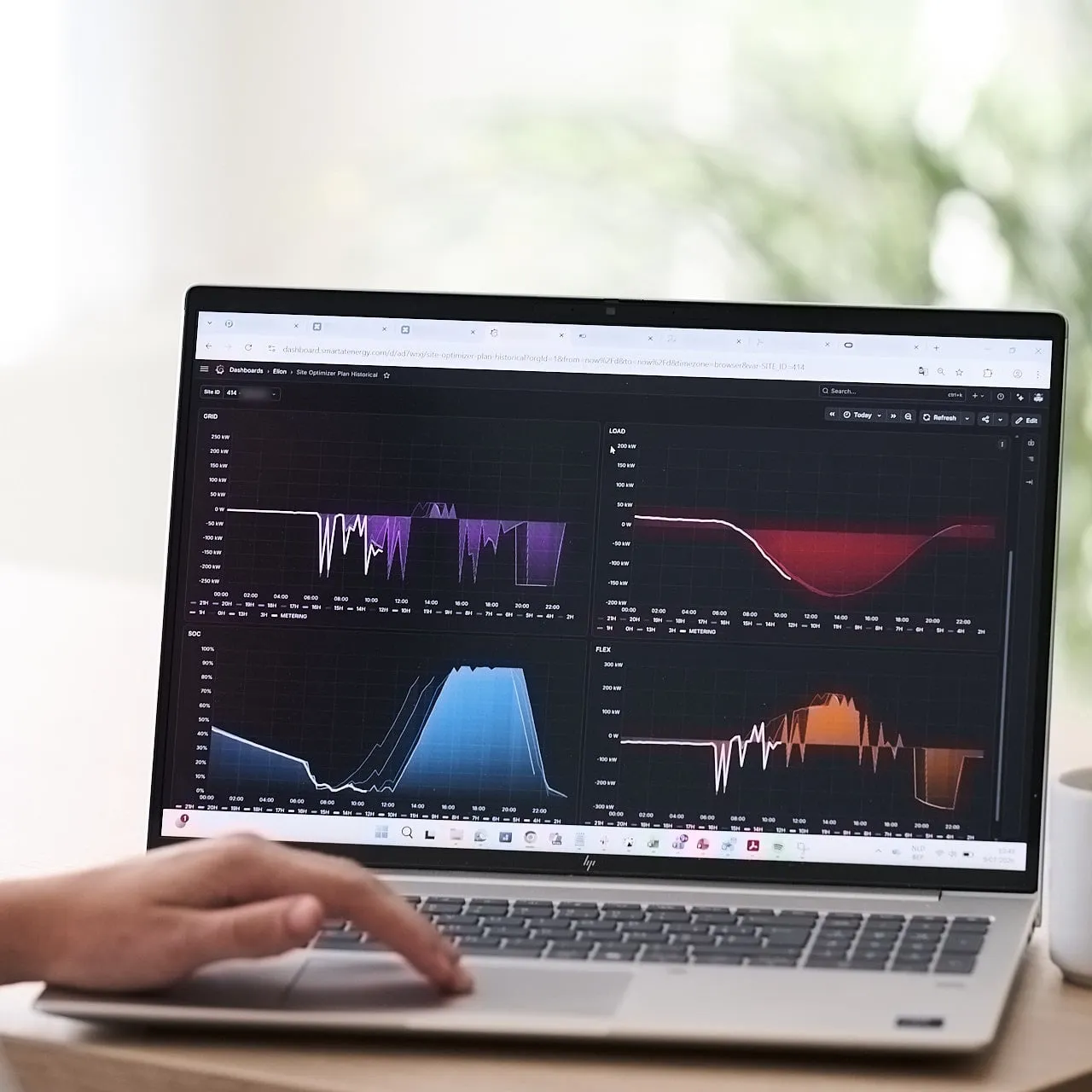
Energy flexibility, the backbone of sustainable energy
Sustainable energy isn't just about solar panels, batteries or electrification. It's mainly about smartly aligning production, consumption and market prices. Whoever can steer, shift or store energy at the right moment gets more out of the same installations and keeps a tighter grip on energy costs. That takes an investment, but doing nothing ultimately costs far more.

Prefer watching over reading? Discover the video here.
Key takeaways
- Flexibility makes sustainable energy usable, because production and consumption rarely align perfectly.
- A flexible energy system lowers your costs and makes you more resilient against price spikes and grid pressure.
- A battery isn't necessarily the first step; start by mapping your company's flexibility potential.
- Overinvesting is just as risky as reacting too late: sizing and control need to match the real consumption profile.
- Don't ask “What does flexibility cost?”, ask “What does it cost to not move with the market?”
Why does sustainable energy need flexibility?
Renewable energy doesn't run on command. The sun and wind don't keep office hours, but consumption often does. That creates a constant gap between when energy is available and when you need it. Flexibility bridges that gap. It makes it possible to shift consumption, deploy storage intelligently, control installations and respond to market signals. According to The International Energy Agency, this flexibility is essential to keep electricity systems that rely heavily on variable renewable output trustworthy and affordable.
“A flexible energy system also offers protection in uncertain times,” says Thomas Van Broeck, CEO of Strado Group. “When energy prices suddenly rise, grid pressure increases or geopolitical tension weighs on the energy market again, a company with a flexible consumption profile has more room to manoeuvre. It gains more freedom in how and when it uses energy. Even a small amount of control capacity makes the difference between watching helplessly and steering with purpose.”
Where does flexibility sit in the energy chain?
Flexibility is rarely created with a single device or a single investment. It emerges when different links in the energy chain connect: contracts, market access, forecasting, control strategies and physical installations.
This 'chain thinking' becomes more relevant every day. Belgium's updated System Balancing Philosophy from CREG and Elia explicitly links the future affordability and robustness of the electricity system to more renewable energy, electrification and active end-user participation, including through battery control.
Consider these building blocks:
- Smarter consumption: shifting consumption to more favorable moments
- Steering existing assets: e.g. charging stations, HVAC, cooling or production processes
- Storage: charging and discharging a battery based on the site's needs and market conditions
- Market link: responding to price signals, imbalance or other flexibility opportunities
- Forecasting and control strategy: making decisions based on what is likely to happen, not just what is happening now.
Why do so many companies still react too late?
Many companies only spring into action once the pressure is already high: during an energy crisis, a heatwave or a period of exceptionally high prices. By the time an installation is designed, ordered and put in place, the peak moment has often already passed. “Panic still proves to be the biggest motivator far too often,” Thomas notes.
“Once the market comes under pressure, installers' order books fill up fast. But flexibility is naturally easier to build before the urgency hits. Whoever waits until things really heat up usually pays more, later, and with fewer options. That doesn't mean every company needs to launch a full flexibility project tomorrow. But it's wise to know today which possibilities exist on-site and where gains can be made without major investment. That groundwork may not be glamorous, but it quietly prepares you for the future.”
The cost of doing nothing still isn't factored into far too many ROI calculations.

So, investing in a battery right away isn't a must?
“Flexibility starts with insight, not with an order,” says Emiel Ghyselen, Business Director at Stelmo, firmly. “Many companies already have solar panels, charging stations or other consumers today. Start by steering those more intelligently. Only after that does the question of a battery, and the right capacity, become relevant. My advice? Size it based on the site's actual profile. More isn't always better: a system that's much bigger than real consumption puts your business case under pressure. In Belgium too, flexibility increasingly comes down to using grid capacity more intelligently, not simply building bigger.”
Possible next steps, depending on your situation:
Situation on-site | Logical first step | Risk |
Solar panels are already in place | Align production and consumption | Too much focus on injection without control |
Many controllable consumers | Shift consumption and flatten peaks | Not including assets in the control strategy |
Charging stations or HVAC present | Link smart control to site priorities | Letting comfort or operations take priority without optimization |
Recurring peaks or price sensitivity | Investigate a tailored battery case for the site | Oversizing |
What does flexibility ultimately deliver?
Far more than a lower bill. A flexible energy system gives you more control over timing, risk and return. “For installers, this creates a stronger customer story, because the value of an installation goes well beyond the hardware. Energy managers gain extra levers to steer costs, peaks and investments with confidence. And for energy partners, it opens the door to scalable service models around control, optimization and market access. The conclusion is clear: sustainable energy isn't just a production challenge; it's a coordination challenge. Installing capacity is one step; deciding when and how that capacity gets used matters just as much for the final return. A truth the sector sometimes forgets, whether consciously or not.”
Related insights

Video: What is a control signal and what does it do?
What happens between the energy market and your battery or charging point? This video explains how a control signal combines local data, forecasting, and market information into the right action at the right moment.
FCR, aFRR, and mFRR: which reserve service fits your flexibility?
FCR, aFRR, and mFRR keep the grid in balance. Discover what that means for your assets.

From energy market to asset: how a control signal works
A control signal connects the energy market to the installations on your site. Discover how it works and why the real value lies not in the charge command, but in the data and forecasting behind it.