
From energy market to asset: how a control signal works
A control signal links the energy market to the assets on your site and determines what each device is best off doing at that moment. Many companies see this as a simple charge or discharge command. Emiel Ghyselen, Business Director at Stelmo, explains why the real value lies in the data, forecasting, and decision logic behind it.

Prefer watching over reading? Discover the video here.
What you’ll want to remember
- A control signal connects local asset data with market data such as day-ahead and intraday prices.
- It starts on site, via a gateway that reads out and controls devices.
- A high-quality control signal looks ahead.
- The best control also accounts for the contract, taxes, certificates, and site constraints.
- Without correct technical configuration and the right energy contract, even a smart signal leaves value on the table.
What is a control signal?
A control signal is a digital instruction that determines what an energy asset should do at which moment. Think of charging, discharging, ramping down, activating, or deliberately doing nothing for a while. “Many people think a control signal originates somewhere in the cloud,” Emiel says. “In reality, it simply starts on your site. A local gateway continuously reads out what is happening technically, and only then do we combine that information with market data to decide which action delivers the most value.”
How does a control signal go from market to asset?
In short, this is the step-by-step plan: measure, enrich, calculate, and execute. Otherwise, you’re steering on hope instead of on data. Each step helps determine how much value you get out of an asset.
Here’s how that works in practice:
- Collecting local data on site
The gateway reads out energy measurements, along with device data such as a battery’s charge status and state of health, production, consumption, and the status of flexible loads. - Data to the cloud
There, that data is combined with external market information, such as day-ahead prices, intraday prices, and other market signals. - A mathematical model chooses the best action
The model looks not only at the current moment, but also at what is likely to follow. If high prices are expected, the system can decide to charge up now in order to discharge in a targeted way later. - The signal goes back to the installation
The calculated instruction is sent to the coupled hardware, so that the asset executes the right action locally.
So with a control signal, is it all about anticipation?
“That’s the difference between reactive and smart control,” Emiel says. “A reactive system looks at what is happening; a smart control signal always tries to stay a step ahead. The energy market simply doesn’t wait until you’re ready. Those who only respond to the current quarter-hour often arrive too late at the moment when the greatest value appears. A good model looks at the present and the future at the same time. Extreme price events in sight? Then the system can, for example, deliberately keep a battery around 50 percent capacity. That leaves room in both directions: charging when it becomes advantageous, and discharging when that is necessary or lucrative.”
Why flexibility delivers more than a full battery:
Situation | What a weak signal does | What a high-quality signal does |
High prices expected | Waits until the moment itself | Charges up smartly in advance |
Uncertain price spike ahead | Picks one direction too early | Keeps flexibility in both directions |
Local production rises | Only reacts afterward | Anticipates surplus and capacity |
What makes a control signal high-quality?
Data forms the backbone of every control signal. The more complete and reliable the information, the better the decision. A high-quality control signal starts from multiple data layers at once. Limiting your view to a single price is steering with blinders on.
These data types really count:
- Weather data: from various models and satellite imagery
- Market data: e.g., day-ahead, intraday, and order book information
- Grid and system data: e.g., information on interconnectors
- Local site data: from battery status to consumption patterns and technical limits
That local knowledge in particular is often underestimated. A battery on paper is not yet usable flexibility. You also need to know how the site works, what the contract terms are, and which limits must not be exceeded locally.
Data is everything. But only when market data, weather data, site knowledge, and contract agreements come together does a control signal emerge that truly creates value

Why is steering on market price alone not enough?
Because an energy bill consists of more than one price component. A system that optimizes solely on the day-ahead price can look technically smart yet still steer financially wide of the mark. “On a site controlled behind the meter, contractual margins, taxes, and certificates also come into play,” Emiel explains. “A high-quality control signal therefore optimizes revenue, but also the complete final bill. That’s a fundamental difference.”
Is a good control signal only software?
“Those who think it’s only about software underestimate the last part of the chain,” Emiel emphasizes. “We always couple control to technical follow-up on site,” Emiel says. “Project engineers check, together with installers, whether devices are correctly connected, whether all data comes in properly, and whether the configuration matches the chosen control objective. A nice extra? More of a precondition.”
Where it often goes wrong in practice:
- the wrong devices are coupled
- data comes in incompletely or incorrectly
- a site fails to achieve sufficient uptime
- local constraints are not correctly modeled
- the energy contract doesn't match the chosen control
“Do remember that last one. If you steer on dynamic tariffs while the underlying contract isn’t dynamic, you won’t see that optimization reflected on your final bill.”
What if an asset is temporarily unavailable?
According to Emiel, the risk lies mainly in the timing: “Uptime—the extent to which an asset is effectively available—plays an important role here. If an asset goes down at exactly an extreme price moment, the missed value can be disproportionately large. Put differently: five percent less availability doesn’t automatically mean five percent less value. For reserve services such as aFRR, Elia moreover sends a reference value automatically every 4 seconds, which immediately shows how strongly performance depends on reliable and continuous availability. In short: a high-quality control signal is, beyond being smart, above all very robust.”
How open should such a control signal be?
Emiel: “Open enough not to be locked into a single party, but to work with the parties already active on a site today. A good control signal integrates with suppliers, energy partners, VPP aggregators, and asset owners. Flexibility rarely works in a closed box. The control must fit the reality of the site, not the other way around.”
Related insights
Energy flexibility, the backbone of sustainable energy
Sustainable energy only works when production, consumption and prices are aligned.

Video: What is a control signal and what does it do?
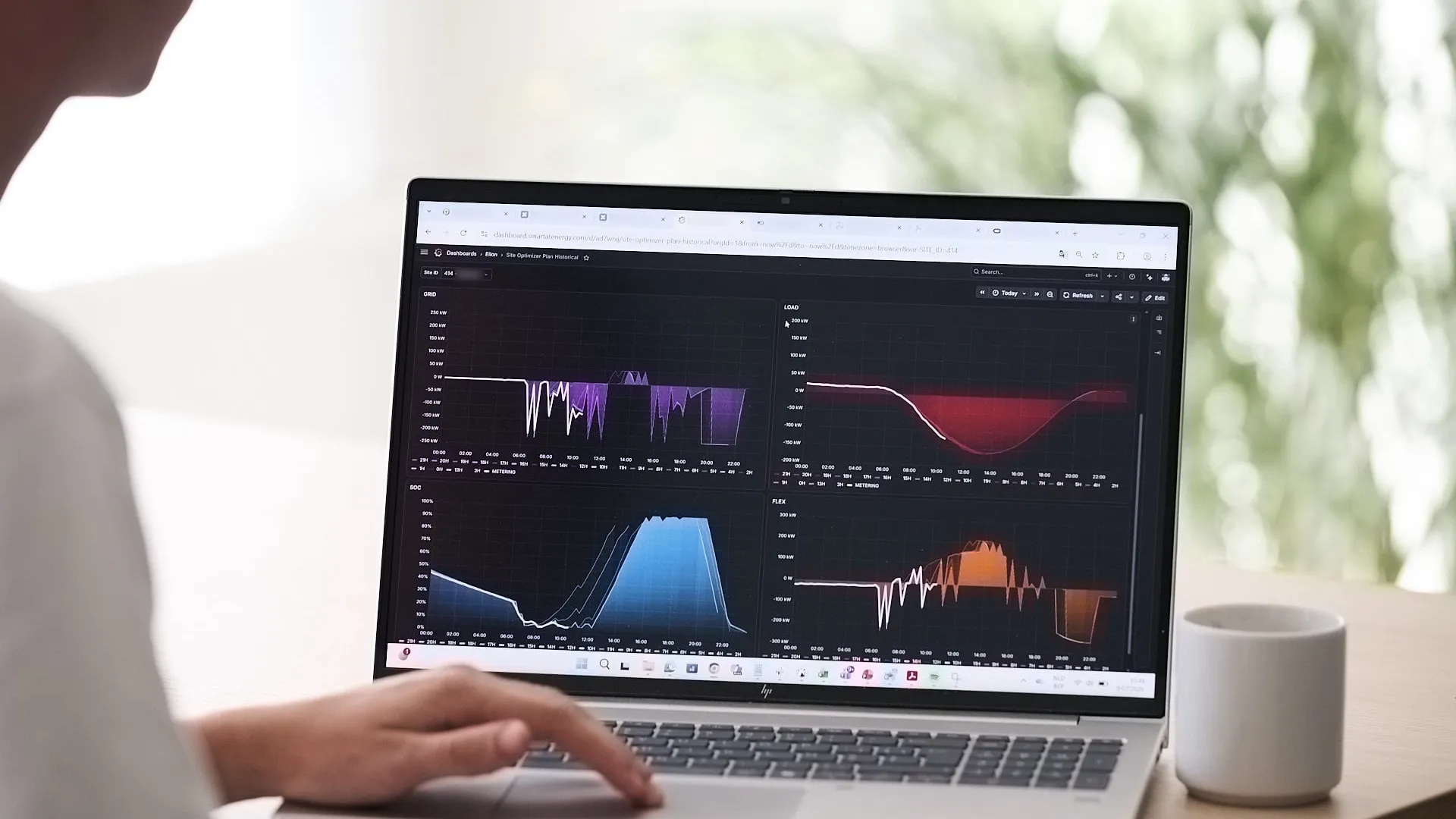
What happens between the energy market and your battery or charging point? This video explains how a control signal combines local data, forecasting, and market information into the right action at the right moment.
FCR, aFRR, and mFRR: which reserve service fits your flexibility?
FCR, aFRR, and mFRR keep the grid in balance. Discover what that means for your assets.